Predictive Empathy: The Soul of the Data Lake
by MDMCO Digital | March 17, 2026 | 5 min read
The Evolution of Memory: From Archives to Living Ecosystems
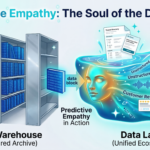
For decades, businesses treated their corporate data like a digital library of their physical ledgers stored in archives. We named these digital libraries Data Warehouses (DWH). They were orderly, structured, and incredibly useful for one thing: telling us exactly what happened yesterday. If you wanted to know how many blue sweaters you sold in Berlin last Tuesday, the DWH was your best friend. It was the ultimate “Archive of the Past.”
But in 2026, knowing what happened yesterday is no longer a competitive advantage—it’s a prerequisite for survival. The real frontier isn’t hindsight; it’s foresight.
The shift from DWH to Data Lakes isn’t just a technical upgrade; it’s a fundamental shift in corporate consciousness. If the DWH is a library, the Data Lake is a living, breathing ocean. It doesn’t demand that data be “filed” in a specific folder before it can enter. It welcomes everything: the raw, the messy, the unstructured. Social media whispers, IoT heartbeats from smart devices, real-time weather patterns, customer voice and comments, and clickstream trails.
Why does this matter for a CEO or a CMO? Because you cannot empathize with a spreadsheet. Empathy requires context, and context is messy. To truly understand a customer—to reach the holy grail of Predictive Empathy—you need more than just their purchase history. You need to see the “ripples” they leave across the entire digital ecosystem. As Nadir Kirgiz discussed in his last article on Agentic Commerce, the future belongs to autonomous agents that can act on these signals, but those agents are only as good as the data ecosystem they live in.
Data Lake: What It Is (and More Importantly, What It Isn’t)
Before we explore how to turn data into empathy, we need to clear the fog. There is a dangerous misconception that a Data Lake is simply a “cheap place to dump all our data.” Let’s be clear: A Data Lake without a strategy is just a Data Swamp. Rule of thumb: Garbage in, garbage out.
- It is NOT just storage: If you are just hoarding data without a governance layer, you aren’t building an asset; you’re accumulating digital debt.
- It is NOT a DWH replacement: They serve different masters. The DWH is for reporting; the Lake is for discovery.
- It IS a playground for AI: You cannot train a sophisticated AI Agent on the rigid rows of a traditional database. AI needs the raw, granular complexity of a Data Lake to find the patterns that a human analyst would never even think to look for.
The Architecture of Empathy: From Cold Data to Warm Insights
How do we transform millions of rows of raw signals into a feeling? This process isn’t magic; it’s a high-precision pipeline we call The Empathy Loop.
1. The Power of Unstructured Context
In a Data Warehouse, you only see the “What.” In a Data Lake, you capture the “Why.” Predictive Empathy relies on Unstructured Data. Think about a customer’s tone in a support chat, the speed at which they scroll through a product page, or environmental triggers like a sudden heatwave. When these disparate signals flow into the Lake, they create a multi-dimensional persona, not just a flat customer ID.
2. Pattern Recognition vs. Guesswork
Traditional marketing relies on segments (e.g., “Males, 30-45, interested in tech”). Predictive Empathy ignores segments and focuses on moments. By leveraging AI on top of the Data Lake, we identify “Micro-Signals.”
Example: The system notices a pattern where a specific user’s behavior changes 48 hours before they typically feel “travel burnout.” It’s not just about a flight discount; it’s about offering a “Peace & Quiet” curated package at the exact moment their stress levels peak.
3. Proactive Problem Solving
The pinnacle of this journey is moving from Reactive to Proactive.
- Reactive: A customer complains about a late delivery.
- Predictive Empathy: The Data Lake identifies a logistical ripple in the supply chain. Before the customer even checks their app, the AI Agent sends a message: “We noticed a delay that might affect your dinner plans. We’ve already contacted a local partner to ensure your ingredients arrive fresh, and here’s a 20% voucher for the inconvenience.” That is empathy at scale.
The MDMCO Perspective: Making Empathy Scalable
Efficiency in a Data Lake is not about how much you store; it’s about latency and accessibility. We emphasize that a successful Data Lake must be:
- Democratized: Data shouldn’t be trapped in IT. It must be accessible to the “Decision Engines” that talk to your customers.
- Governed: Empathy requires trust. If the Data Lake isn’t secure and ethical, the empathy feels like surveillance.
- Liquid: The transition from a signal in the Lake to an action in the storefront must happen in milliseconds.
The Culmination: Winning the Heart of the Algorithmic Era
As we move deeper into 2026, the gap between “Digital Leaders” and “Digital Laggards” will no longer be measured by the size of their databases, but by the depth of their empathy. Data Lakes provide the canvas, and AI provides the brush, but Predictive Empathy is the masterpiece. It is the transition from being a brand that “sells things” to becoming a brand that “understands life.”
The New Currency of Trust
In this new era, customers are weary of surveillance but hungry for understanding. Predictive Empathy allows MDMCO partners to offer a new kind of value proposition: The Luxury of Not Having to Ask. When a system anticipates a need out of a holistic understanding of context, it builds a bond of trust that no discount code can ever match.
Final Thoughts: From Logic to Intuition
The journey from the DWH to the Data Lake is essentially the journey of a business moving from Logic to Intuition.
- Logic tells you that a customer bought a product.
- Intuition (Predictive Empathy) tells you why they bought it and what they will feel next.
The future belongs to the intuitive enterprise. Is your organization still living in the “archive of the past,” or are you ready to dive into the living ecosystem of the future?

Related Posts
Beyond the “Smart Fridge” Myth: Navigating the Reality of Agentic Commerce by Nadir KIRGIZ | March 12, 2026 | 3 min read

From Amateur Snapshots to Editorial Excellence: The MDMCO AI Creative Studio by MDMCO Digital | March 3, 2026 | 3 min read

Building a Winning eCommerce Team: The Ultimate Guide by MDMCO Digital | October 23, 2024 | 12 min read

Gear Up for the November E-Commerce Boom: Your Battle Plan for Digital Domination! by MDMCO Digital | October 17, 2024 | 4 min read
The “Less is More” Paradox: How Minimalism Drives Digital Commerce Success by Nadir KIRGIZ | October 15, 2024 | 3 min read